Three years ago a business could put £1 into paid ads and reliably get £3 or £4 back.
That math is changing.
Paid search costs have climbed 20 to 25 percent in the past year alone. Social CPMs keep rising. Customer acquisition costs across industries are up 40 to 60 percent since 2023. And the old response of "just spend more" no longer works. The cost of that spend now eats margin faster than the growth it buys.
This is not a temporary spike. It is a lasting change. The businesses growing profitably in 2026 are not the ones with the biggest ad budgets. They are the ones that saw this coming and rebuilt how they acquire customers before the math broke completely.
The question is not "how do we cut ad spend?" It is "how do we build a system where paid ads are one part of a larger, more efficient acquisition engine?"
What Matters This Week
This is not a news issue. It is a shift that has been building for two years, and most businesses still budget as if it is 2021.
Here is what is actually going on.
1. The cost of paid acquisition has structurally reset
- What happened: Paid search CPCs have risen 20 to 25 percent year over year across North America, while social CPMs have climbed roughly 9 percent, according to industry benchmarks. Google Ads average CPC in the UK rose 12 percent from 2025 to 2026. Meta CPMs have increased steadily since 2020, with competitive categories now seeing 25–40 CPMs. Customer acquisition costs across all industries have risen 60 percent over the past five years, driven primarily by rising paid media costs. Hawke Media’s 2026 Market Vision Report, which analyzed 17.9 billion impressions, 321 million clicks, and 313 million in ad spend, confirmed that these rising costs are structural, not temporary.
- Why it matters: Budgeting based on historical efficiency metrics no longer works. The cost to acquire a customer is now structurally higher than it was two or three years ago, and businesses that rely on paid channels for 80 percent or more of their new customers are seeing margin compression that cannot be fixed by tweaking bid strategies. The businesses that still grow profitably in 2026 are the ones that have diversified their acquisition channels.
2. Zero-click search is quietly eating into paid and organic performance
- What happened: Nearly 60 percent of Google searches now end without a click to any website. When AI Overviews appear, that zero-click rate climbs, and in Google's full AI Mode it reaches over 90 percent. Organic search traffic has been declining across industries through 2025. AI Overviews have been shown to decrease paid ad click-through rates from roughly 20 percent to just over 6 percent when they appear alongside ads. Gartner predicted this back in 2024, forecasting a 25 percent decline in traditional search volume by 2026.
- Why it matters: Both your organic and paid search channels are getting less efficient. Not because your strategy changed, but because the platforms themselves are designed to keep users from clicking away. Every dollar you spend on paid search now competes with AI generated answers that satisfy intent before a user ever sees your ad.
3. Businesses that diversify their channels see CAC rise at half the rate
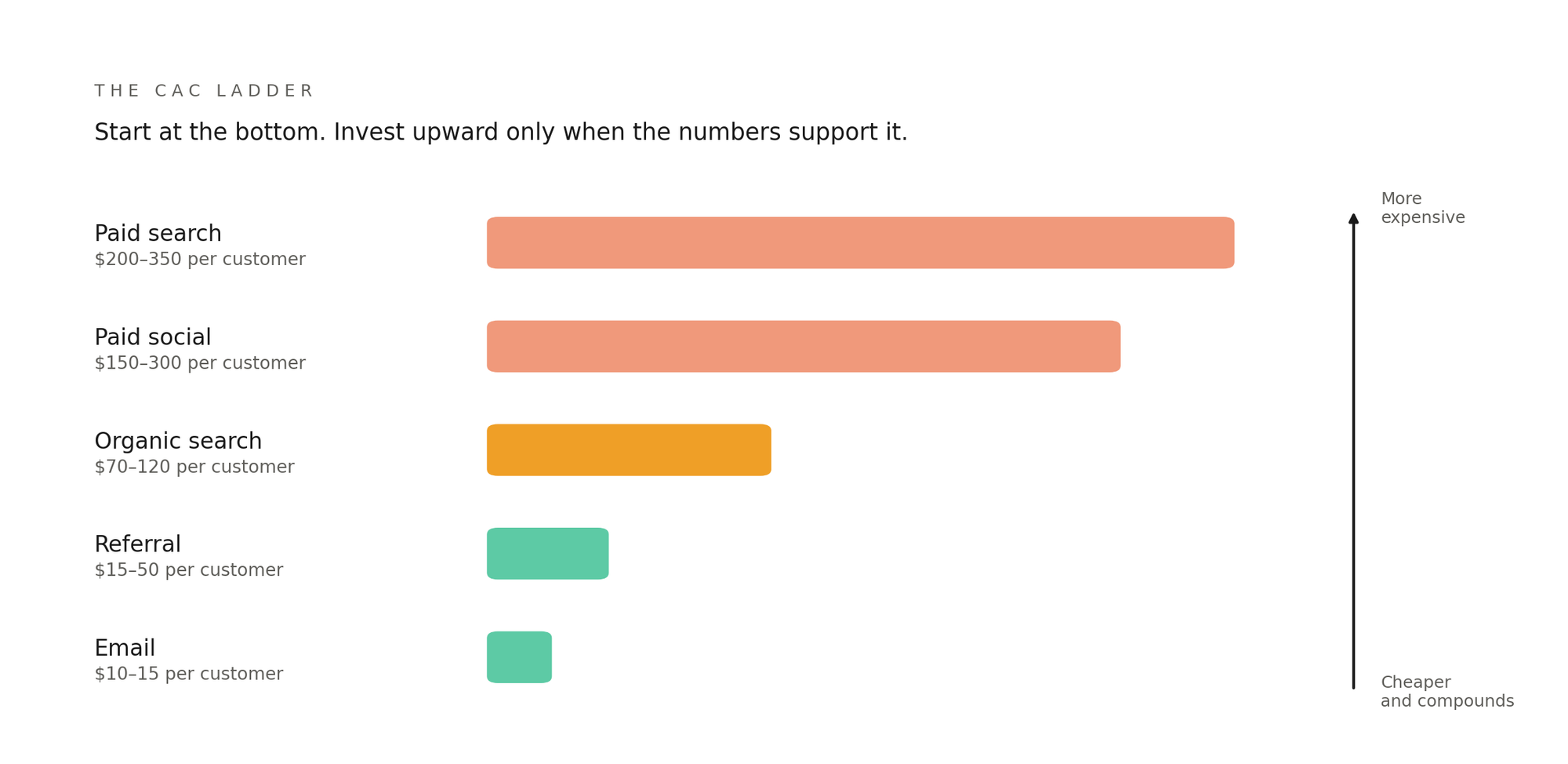
- What happened: According to Forrester Research, companies that rely primarily on paid channels have seen their customer acquisition costs increase twice as fast as those with diversified channel mixes. Referral marketing delivers the lowest CAC of any active channel at $15 to $50 per customer, compared to $200 to $350 for paid search and $150 to $300 for paid social. Email marketing delivers an average ROI of $36 for every $1 spent, rising to $45 in retail and ecommerce.
- Why it matters: The channels with the lowest cost and the most stability are owned and earned, not paid. Email, referral programs, organic search, and content marketing all have lower CAC and higher stability than paid channels. The businesses holding margin in 2026 are not cutting their ad budgets. They are investing in these lower cost channels alongside their paid spend, which brings down the blended cost of acquiring a customer.
4. AI is becoming a practical lever for reducing acquisition costs
- What happened: AI is no longer just a test budget. It is delivering measurable CAC reductions. Bouygues Telecom, a major French telecommunications company, deployed Perion's Outmax AI agent across its marketing campaigns in May 2026 and reduced customer acquisition costs by 34 percent while maintaining premium inventory access. Google's AI Max, which exited beta in April 2026, delivers an average 14 percent lift in conversions at similar CPA or ROAS, with that number rising to 27 percent for advertisers previously weighted toward exact and phrase match keywords. AI powered personalization has been shown to increase conversion rates by roughly 25 percent, which directly lowers effective CAC by turning more existing traffic into paying customers.
- Why it matters: AI is not a magic solution, but it is producing real, measurable efficiency gains when applied to specific parts of the acquisition funnel: creative testing, audience modeling, bid optimization, and on site personalization. The businesses deploying AI strategically, rather than experimentally, are pulling ahead.
5. Creative velocity and retention are the new cost controls
- What happened: In a rising cost environment, ads fatigue faster. Hawke Media's data shows that many winning creatives peak quickly and decay within days. Brands that rely on a small set of hero ads see performance swing wildly. Brands that ship creative continuously, testing new angles, formats, and hooks weekly, stabilize results even as CPMs climb. At the same time, the brands winning in 2026 have fundamentally rebalanced acquisition and retention. Acquiring a new customer now costs 5 to 25 times more than retaining an existing one. For many direct to consumer brands, the first order is a loss making event; profitability only arrives when that customer returns.
- Why it matters: The old playbook of scaling purely through new customer acquisition is breaking. The businesses pulling ahead are the ones that treat creative testing and customer retention as core performance levers, not afterthoughts. A healthy LTV to CAC ratio of at least 3 to 1 is the minimum benchmark for sustainable growth.
Tool of the Week
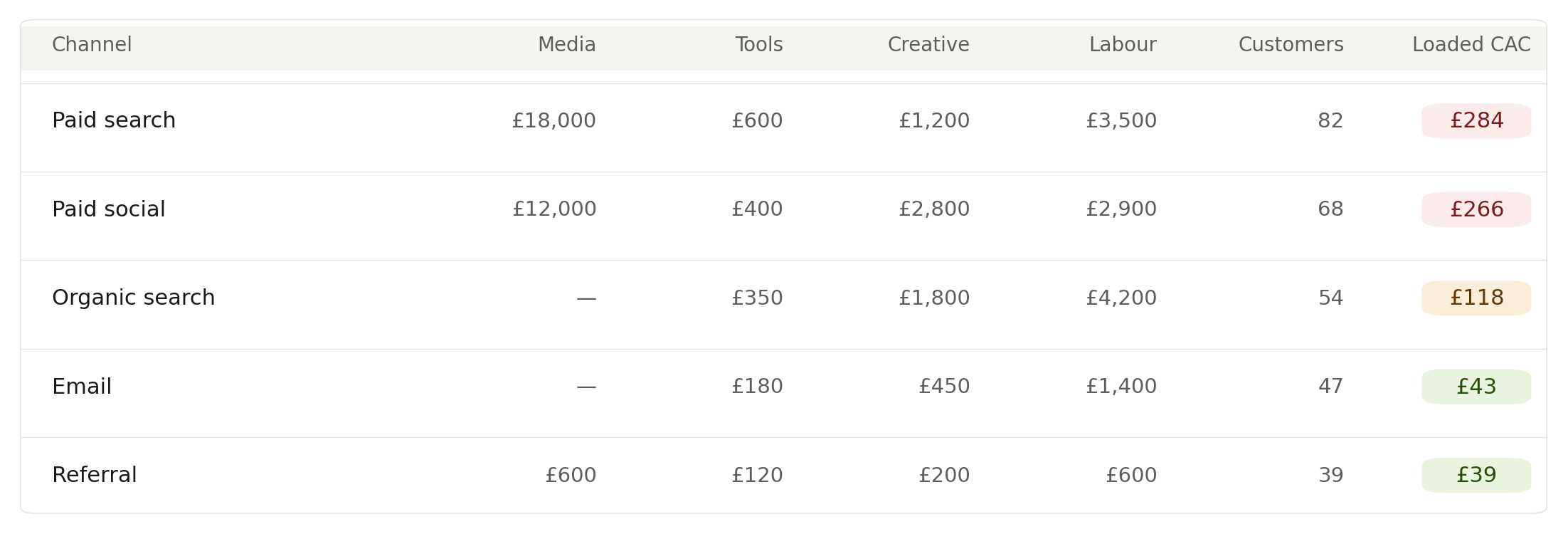
Tool: A simple CAC audit spreadsheet (Google Sheets, Excel, or your own reporting tool)
What it does: Shows you exactly what you are paying for a customer across every channel so you can see which channels are actually profitable and which are quietly draining margin.
Use it for: A free performance audit. In 30 minutes you will know your true fully loaded CAC for each channel, including ad spend, platform fees, creative production, and team time. Most businesses underestimate their actual CAC by 25 to 40 percent because they only count media spend.
Quick play:
- Pull your total marketing spend for the last 90 days. Include ad spend, agency fees, creative production, software subscriptions, and allocated team salaries.
- Divide that total by the number of new customers acquired in the same period. That is your blended CAC.
- Now repeat for each channel individually. Paid search. Paid social. Email. Organic. Referral. Partnerships.
- Compare each channel CAC against the customer lifetime value from that channel. If the ratio is below 3 to 1, that channel needs attention.
- Look for the channels where CAC is rising fastest. Those are your early warning signals.
Growth Play of the Week
The Play: Building a diversified acquisition system that lowers your blended CAC
Problem: Your business relies on one or two paid channels for the majority of new customers, and those channels keep getting more expensive. Every quarter your margin compresses a little more.
Stack:
- A CAC audit by channel (from the Tool of the Week)
- An email or SMS platform (Klaviyo, Omnisend, or similar)
- A referral or loyalty program (Smile.io, Yotpo, or similar)
- A content calendar for organic and earned channels
Workflow:
- Run the CAC audit. Know your true cost to acquire a customer from every channel. Separate platform reported CPA from fully loaded CAC, which includes all associated costs.
- Identify the channels where CAC is rising fastest. These are not necessarily the channels to cut. They are the channels where efficiency gains or budget reallocation will have the most impact.
- Invest in the channels with the lowest CAC and highest stability. Email marketing delivers $36 to $45 for every $1 spent. Referral programs produce customers at $15 to $50 each. Organic search averages $70 to $120 per customer. These channels compound over time and cost nothing at the margin once built.
- Use AI to improve conversion on the traffic you already have. AI powered personalization on your website can lift conversion rates by roughly 25 percent, which means more customers from the same traffic without increasing ad spend.
- Increase creative velocity on paid channels. Test new ad variations weekly, not monthly. Ads fatigue faster in 2026. The brands that stabilize paid performance are shipping more creative, not just optimizing bids.
- Track your LTV to CAC ratio monthly. Set a minimum threshold of 3 to 1. If a channel falls below that, investigate before scaling further.
Outcome:
→ A more resilient acquisition system that does not break when one channel gets more expensive.
→ Lower blended CAC as owned and earned channels grow to complement paid.
→ Margin that holds steady even as media costs continue to rise.
Case Study
Bouygues Telecom, one of France's largest telecommunications providers, faced the same challenge many businesses are confronting in 2026. Customer acquisition costs were rising, and the efficiency of traditional campaign management was plateauing.
In May 2026, the company deployed Perion's Outmax AI agent across its marketing campaigns, starting with a Fiber to the Home acquisition effort. The AI agent was tasked with handling audience modeling, bid optimization, and creative allocation across multiple inventory sources.
The result was a 34 percent reduction in customer acquisition costs. Campaign carbon intensity dropped by 51 percent. Premium inventory access was maintained throughout, and engagement metrics actually improved.
This was not about replacing human marketers. It was about giving them a tool that optimized the parts of campaign management where machines have an edge: processing thousands of signals simultaneously and adjusting bids in real time based on conversion probability.
The lesson is straightforward. AI in performance marketing is no longer experimental. It is delivering measurable, near term cost reductions for the businesses that deploy it with clear objectives and proper measurement. The window to gain an advantage from it is open now, but it will not stay open indefinitely.
Trend to Watch
Every efficient acquisition channel goes through a cycle. Early adopters get low costs. The market catches on. Costs rise. Latecomers pay a premium.
This happened with Google Ads between 2005 and 2015. It happened with Facebook Ads between 2015 and 2022. It is now happening with TikTok, where CPMs are rising rapidly as more brands compete for the same audiences.
But there are two trends worth paying attention to right now.
First, retail media is becoming a serious performance channel. Global retail media spend is projected to reach nearly $197 billion in 2026, growing faster than almost any other digital channel. For businesses selling physical products, advertising on marketplaces like Amazon, Walmart, and an expanding network of retail media platforms offers closed loop attribution that most other channels cannot match.
Second, AI powered bidding and creative tools are compressing the advantage that sophisticated advertisers used to have. When every business has access to similar algorithms, the algorithm itself stops being a differentiator. What replaces it is the quality and velocity of creative, the strength of first party data, and the ability to measure what actually drives revenue rather than what looks good in a platform dashboard.
The businesses that understand this shift now will build the measurement and creative systems to compete. Those that keep optimizing the old metrics will watch their costs rise and wonder why.
Prompt of the Week
Open your ads manager, your analytics platform, and a blank spreadsheet.
Ask yourself these five questions:
- What is my true fully loaded CAC for each channel, not just the platform reported CPA?
- Which channel's CAC has risen the most in the last 12 months?
- What is my LTV to CAC ratio per channel? Which channels are above 3 to 1 and which are below?
- How much of my new customer revenue comes from owned channels (email, organic, referral) versus paid channels?
- If I had to reduce my paid acquisition budget by 20 percent tomorrow and still hit my growth targets, what would I do first?
The answers to these questions tell you exactly where to focus. Most businesses never ask them systematically. The ones that do make better decisions faster.
Rising acquisition costs do not have to mean shrinking margins. They do mean the old playbook needs a rewrite. If you want help auditing your channels, rebalancing your mix, and building a more resilient acquisition system, we should talk.
→ Reply “AI” and my team will help you figure out where to start, or