I see this every week when I audit a business. The tools are there. Clay, Apollo, HubSpot, a writing assistant, maybe a chatbot. But revenue is still flat. Growth is still manual. Nothing compounds.
The problem is never the tool. It is where the tool sits. A tool on its own does one job. A tool plugged into a system does five. This week, I am breaking down exactly which AI tools are worth your attention right now, and more importantly, where each one actually belongs inside your growth system.
What Matters This Week
- Clay is one of the most powerful prospecting tools most founders are barely using
What Happened: Clay pulls data from dozens of sources and lets you enrich, score, and personalise outreach at scale without a full SDR team. Most people use it to build a list. The ones winning use it to build a system. Connect it to your ICP definition at the Attract stage, feed scored leads directly into your nurture sequences, and outreach starts feeling like it knows the person rather than a mass blast.
Why it matters: Clay on its own is a spreadsheet. Clay plugged into Attract and Nurture is a lead engine.
- AI-referred traffic now converts 4 to 5 times better than standard organic
What Happened: Visitors clicking through from ChatGPT, Perplexity, or Google AI Overviews are converting at 4 to 5 times the rate of standard organic search, across multiple independent studies published in 2025 and 2026. These are buyers who arrived with context, intent, and trust already built. Most businesses have no strategy for this channel at all.
Why it matters: Being cited inside AI platforms is the new SEO. The window to build this position is open now and closing fast.
- Predictive churn tools are cheap and barely used outside enterprise
What Happened: Tools like ChurnZero, Vitally, and even well-configured HubSpot can now flag customers at risk of leaving before they leave. Most businesses only notice churn after the cancellation email. Plugged into the Activate stage, a predictive churn model triggers re-engagement sequences before the customer even knows they are drifting. The difference between a churned customer and a retained one is often a single well-timed touchpoint.
Why it matters: Fixing churn at Stage 4 costs nothing compared to replacing that customer at Stage 1.
- Most AI writing tools are being used backwards
What Happened: Founders use AI to write content faster. That is fine. But the businesses getting real leverage use AI to test offer framing at scale. Write ten versions of your core promise. Run them as ads. See which outcome lands. Feed the winner back into your landing page, your emails, your outreach. That is AI working inside the Convert stage. Writing faster is a time save. Testing faster is a revenue multiplier.
Why it matters: Speed is a nice bonus. But using AI to find the message that converts is what actually moves revenue.
Tool Of The Week
Tool: Clay
What it does: Finds, enriches, scores, and personalises outbound leads using data from dozens of sources and AI.
Use it for: Building a lead engine at the Attract stage that feeds warm, scored prospects into your nurture sequences automatically.
- Define your ICP tightly first. Job title, company size, industry, one or two buying signals. Clay is only as good as the brief you give it. Garbage in, garbage out.
- Build your enrichment flow. Pull in LinkedIn data, company funding info, tech stack, recent news. Use AI columns to score each lead against your ICP and write a personalised first line based on what you found.
- Connect the output to your outreach tool, whether that is Instantly, Smartlead, or your CRM. Scored leads flow straight into a nurture sequence. You are not sending blasts anymore. You are sending relevant messages to the right people at the right time.
THE MISTAKE TO AVOID: Most people use Clay to build a list and then manually send emails. That is just a faster version of what they were already doing. The real value comes when Clay is connected upstream to your ICP definition and downstream to your sequences. The tool is the middle of the system, not the whole system.
Growth Play of the Week
Build your AI-powered Attract to Nurture pipeline.
Problem: Prospecting is manual, slow, and inconsistent. Your best leads are getting generic outreach and going cold before they ever reach a conversation.
Stack:
- Clay
- Apollo or LinkedIn Sales Nav
- Instantly or Smartlead
- HubSpot or your CRM
Workflow:
- Write your ICP in one sentence. Not a job title. A specific person with a specific problem. Feed this into Clay as your filter criteria.
- Build your Clay table. Pull LinkedIn data, company size, funding stage, tech stack, and any relevant buying signals. Add an AI column that scores each lead 1 to 10 against your ICP and writes a personalised opening line.
- Set a score threshold. Leads above 7 go into your active outreach sequence. Leads between 4 and 6 go into a slower nurture. Leads below 4 get filtered out. You only spend time on qualified demand.
- Connect to your outreach tool. Sequences run automatically. Every message is personalised. You are notified when someone replies so you step in at the right moment.
- Feed replies and conversions back into your CRM. Track which ICP signals produced the best leads. Refine Clay every month. The system gets better every time you run it.
Outcome:
- Consistent pipeline without manual prospecting every week
- Higher reply rates because messages are actually relevant
- A system that improves with every iteration instead of resetting
Case Study
How we turned $11,500 into $180,000 using a connected growth system.
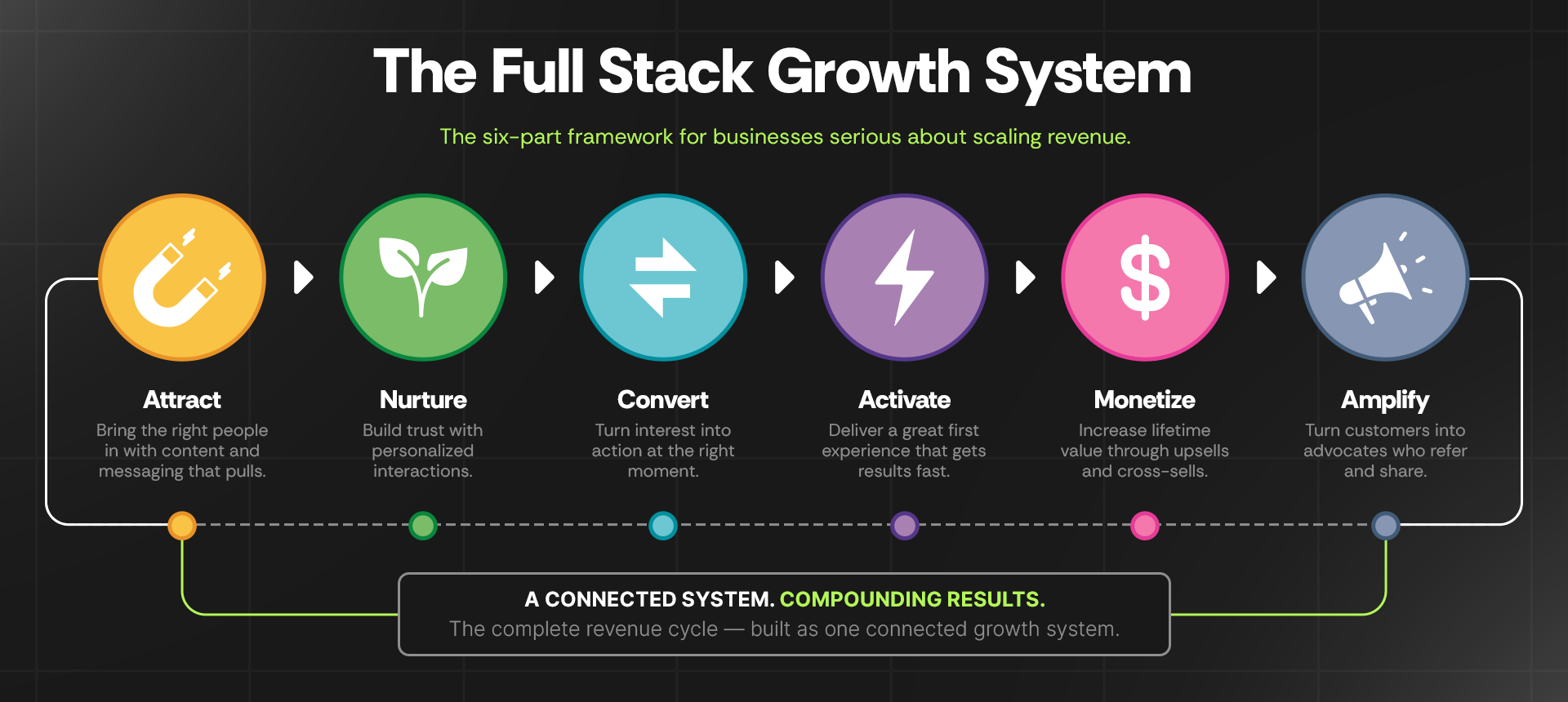
What we did: We took one of our own products that had stopped growing. We had the tools. We had the budget. We had the team. What we didn't have was a system connecting all of it. So we ran it through the Full Stack Growth System, a six-stage framework that covers the complete revenue cycle from the first time someone discovers you to the moment they bring you their next customer.
Attract pulled the right people in. Nurture warmed them up before any conversation started. Convert turned that intent into paying customers. Activate got them to their first win fast. Monetize captured the full value. Amplify turned those customers into referrals that fed straight back into Attract.
$11,500 in total spend. $180,000 in revenue. 15x return.
Why it worked: Every stage had one job and fed directly into the next. Nothing ran in isolation. Each win compounded into the one after it. The tools didn't do this. The system did. The tools just made each stage faster and sharper. Without the system connecting them, they would have stayed exactly what most businesses have, a stack of subscriptions producing nothing.
Takeaway: This is the difference between buying tools and building a system. One resets every month. The other compounds.
Trend To Watch
The AI Tool market is getting noisier. The gap between tool buyers and system builders is getting wider.
There are now thousands of AI tools competing for your attention and your budget. Most of them do one thing reasonably well. Founders are buying them and feeling busy. Revenue isn't moving.
The businesses pulling ahead are not buying more tools. They are asking a different question: where does this sit in my system? Which stage does it strengthen? What does it feed into and what feeds into it?
That shift in thinking is the difference between a founder with a lot of subscriptions and a founder with a growth engine. The tools are mostly cheap. The thinking is what separates the two.
I put together The Full Stack Growth System as a PDF. It walks through all six stages and every module inside each one.
→ Reply "AI" and I'll send it straight to your inbox.
Prefer we look at your setup directly? I've opened 5 slots for a Free Growth Audit this week. My team will dig into your actual system, find the gaps costing you conversions, and tell you the one fix that'll move revenue most. These usually run $250 – but the first 5 are free.