It isn't just advertising. It isn't just social media.
It's the complete journey that takes someone from discovering a business to buying, returning, and recommending it.
That's what a growth system is.
Most people look at successful companies and try to copy the parts they can see. The ads. The website. The store design. But copying one piece rarely produces the same result. The results come from how all the parts work together.
IKEA is a perfect example. Let's take a look!
The IKEA Growth System
From the outside, IKEA sells furniture. But the customer experience does much more than display products.
IKEA combines inspiration, product education, affordability, convenience and repeat-purchase opportunities into one connected growth system. Using the Full Stack Growth Framework, the model works like this.
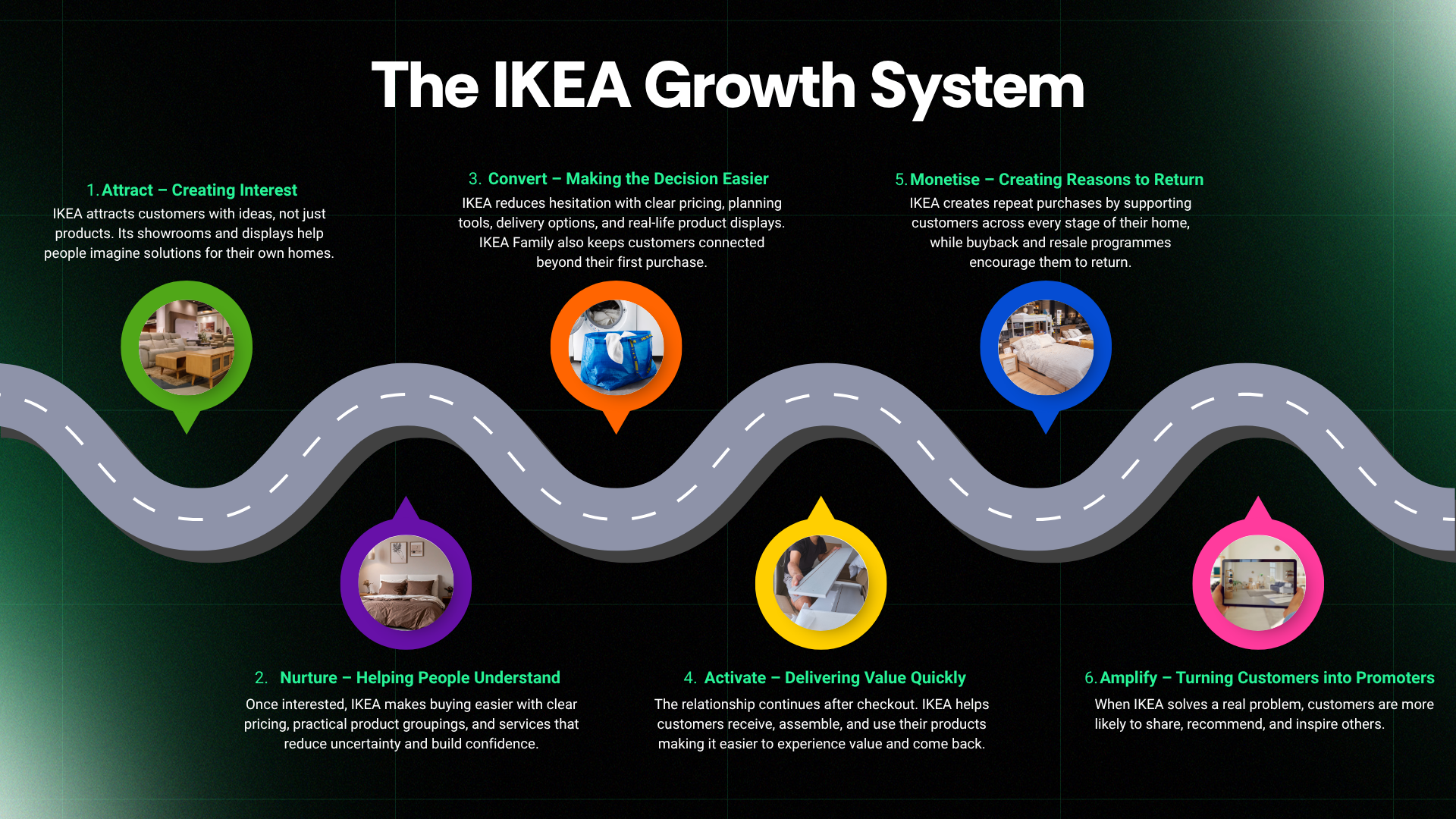
1. Attract – Creating Interest
IKEA attracts customers with ideas, not just products.
Its showrooms, room layouts and displays help people imagine how their own homes could look and feel. Customers are not only seeing a sofa, desk or storage unit. They are seeing a possible solution to a problem in their home.
The scale is significant. In FY25, IKEA stores recorded 915 million visits, up from 899 million in FY24. This is more than the population of Europe, although it represents visits rather than unique individuals.
IKEA’s websites recorded 4.6 billion visits in FY24. The original figure of 4.1 billion was inaccurate. The 28% growth figure should not be attached to the global website total; it refers to the increase in online visitation reported in specific IKEA retail reporting.
But attracting attention is not enough. It must then help customers move from interest to understanding.
2. Nurture – Helping People Understand
Once someone is interested, IKEA makes the decision easier.
Products are shown in real rooms. Prices are visible. Items are grouped around practical needs, such as cooking, sleeping, working or organising a small space. People don’t have to imagine every possible use by themselves.
The store, website, delivery options and assembly services also help reduce uncertainty. This makes the buying process easier.
In FY24, IKEA invested over €2.1 billion in lowering prices across 63 markets. This was a strategic investment in affordability, not simply a promotional discount. Lower prices helped boost store visitation by 3.3% and online visitation by 28%. When you remove barriers, more people move forward.
The effect continued into FY25. IKEA’s total retail sales declined from €45.1 billion in FY24 to €44.6 billion in FY25, but sales volumes increased by 2.6% as lower prices encouraged more customers to buy.
Online sales represented 28% of total IKEA sales in FY25, compared with 26% in FY24. The important point is not that one channel replaced another. IKEA makes it possible for customers to discover, compare and purchase through whichever channel is most convenient.
3. Convert – Making the Decision Easier
IKEA’s conversion experience is designed to reduce hesitation.
Products are displayed in context. Prices are easy to find. Related items are placed together. The store layout creates a guided journey, while the website provides product information, availability, delivery options and planning tools.
This helps customers answer the questions that commonly delay a purchase:
- Will this fit my home?
- How will it look with my existing furniture?
- What else do I need?
- How much will the complete solution cost?
- Can I get it delivered or assemble it myself?
Conversion also creates an opportunity for a longer-term relationship through IKEA Family, IKEA’s free customer loyalty programme.
In June 2026, IKEA Family surpassed 200 million members globally and was growing by approximately 1,800 new members per hour. The programme offers member discounts, benefits and rewards, giving IKEA a way to encourage repeat engagement beyond the initial purchase.
The older claim that IKEA Family members accounted for 43% of IKEA sales in 2013 should be removed unless supported by the original primary source. The claim is difficult to interpret because it is unclear whether it refers to revenue, transactions or purchases where a member identification was used.
4. Activate – Delivering Value Quickly
The relationship doesn't end at checkout.
Customers still need to receive, assemble and use the product. IKEA supports this stage through product instructions, delivery services, planning assistance and assembly options.
The goal is to shorten the time between purchase and usefulness. A desk is more valuable when it can be assembled and used quickly. A wardrobe is more valuable when the customer understands how it fits into the room. A kitchen is more valuable when the planning and installation process feels manageable.
IKEA also connects its physical and digital experiences. Customers can browse online, visit a showroom, check product availability, order through the website and choose between collection and delivery options.
This connected experience matters because furniture purchases are rarely isolated decisions. Someone who buys a desk may later need a chair, lighting or storage. Someone who buys a bed may later need bedside tables, wardrobes or home textiles.
5. Monetise – Creating Reasons to Return
IKEA doesn't depend on a single transaction.
Its product range is organised around rooms, lifestyles and recurring household needs. Once customers improve one part of their home, they have a natural reason to consider another part.
The product architecture also supports complementary purchases. A customer may return for:
- Storage to improve an existing room.
- Lighting to complete a workspace.
- Organisation products for a new kitchen.
- Textiles or accessories to refresh a bedroom.
- Additional furniture after moving house or changing lifestyle.
IKEA’s furniture buyback and resale programmes add another layer to the model. They give customers a way to return eligible furniture for store credit, while helping IKEA bring customers back into its stores and participate in the second-hand market.
A reported US programme result suggested that buyback participants made 50% more visits during the following six months. This should be treated as a US-specific programme finding, not as a universal global IKEA result.
The broader strategic principle is clear: a circular service can create both sustainability value and additional customer touchpoints.
6. Amplify – Turning Customers into Promoters
A useful product experience can generate recommendations, reviews and word of mouth.
IKEA’s strongest amplification asset is the practical nature of its products. Customers can show how they organised a small room, built a home office or created more storage. The experience becomes easy to demonstrate and share.
A third-party survey reported an IKEA NPS of 22, with 51% of respondents classified as promoters. This suggests positive advocacy in that sample, but it shouldn't be interpreted as a definitive global customer metric.
IKEA's system took years to build. Yours doesn't have to. I've put together a breakdown of the Full Stack Growth System so you can easily apply it to your own business.
The System View
Look at the full journey, and you can see how the pieces work together:
- Inspiration attracts attention.
- Context and transparent pricing build understanding.
- Convenience reduces purchase hesitation.
- A functional product delivers value.
- Complementary needs create repeat purchases.
- Positive experiences generate recommendations.
IKEA is not simply selling furniture. It is designing a connected customer system that turns inspiration into action, action into value and value into repeat demand.
What This Means for Your Business
Copying IKEA's social media won't create IKEA's growth. Copying its store displays won't create IKEA's growth. The results come from how all the parts work together.
At Magnet, this is how we look at business growth. We don't only ask "how can you get more attention."
We also ask: "Why should people choose you? What makes them trust you? What makes buying feel easy? What happens after they buy? Why would they come back? Why would they recommend you?"
Growth isn't one campaign. It's the complete customer journey working as one connected process.
The strongest growth systems are often hard to see. But you can see the results in the way customers discover, choose, buy from, return to, and talk about a business.
Want us to do this for your business? Book a free Growth Audit and my team will map your full customer journey, show you the biggest leak, and walk you through exactly how to fix it.