The old playbook was simple. Build something better. Protect it. Win.
But now, that playbook is breaking. AI has made building cheap and fast. When everyone can ship a good product in weeks, the product stops being the advantage. The advantage shifts to who can reach customers, earn their trust, and keep them coming back.
Most businesses haven't adjusted. This week I want to show you exactly what's changed, and how to build distribution as your real moat.
What Matters This Week
1. Building software is now a commodity
- What happened: The martech landscape grew from 150 tools in 2011 to 15,384 in 2025. AI has collapsed development costs to near zero. Any team can now ship a working product in weeks. As Noah Kagan put it after building three apps in a single weekend: "Making software is now trivial, but actually getting people to use it and then really creating moats or network effects is the valuable part."
- Why it matters: When everyone can build, the product stops being the differentiator. The audience is.
2. The investment community has already shifted
- What happened: AI captured ~53% of all VC in 2025. Top funds are now digging into repeatable sales engines and proprietary workflows, not product screenshots. GTMfund's Paul Irving said it plainly: distribution is the last sustainable moat in the AI era.
- Why it matters: The people writing billion-dollar cheques have already updated their framework. So your pitch should too.
3. Distribution beats product every time
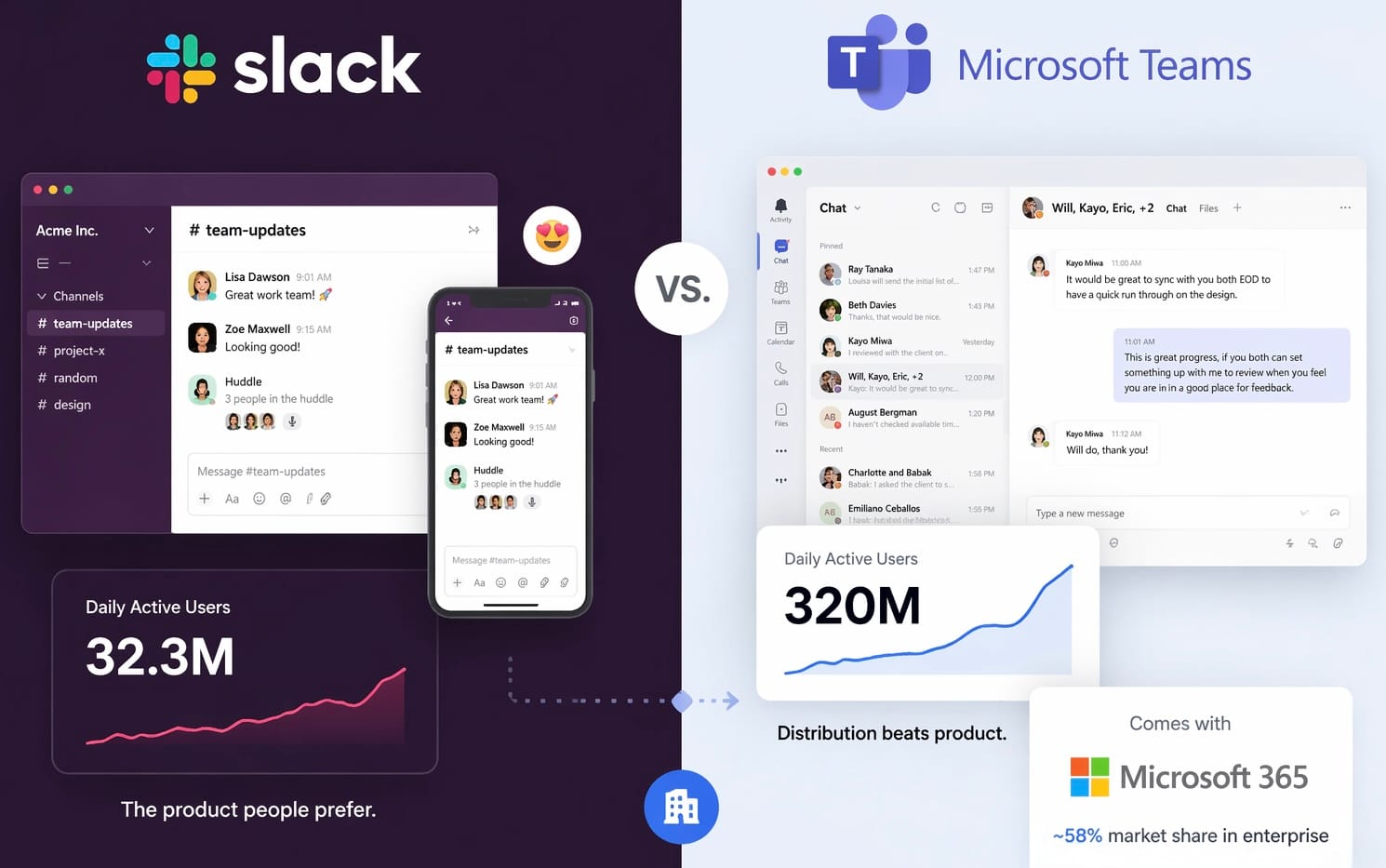
- What happened: Slack launched in 2013 with a product people genuinely loved. Microsoft launched Teams with a worse product and bundled it into Microsoft 365, which held 58 percent of the enterprise market. Teams hit 320 million daily users. Slack hit 32 million. A nearly 10‑to‑1 ratio in favour of the worse product. Distribution won.
- Why it matters: It doesn't matter how good your product is if nobody finds it.
4. The businesses that win sell outcomes, not features
- What happened: Gartner's 2024 B2B Buying Study found that 87 percent of deals stall because sellers focus on features rather than business outcomes. The data is clear: companies that adopt outcome-based selling see win rates jump by 12 percent, deal sizes grow by 7 percent, and sales cycles shorten by over 10 percent compared to feature-focused selling. Forrester found that companies using outcome-based selling close 29 percent faster overall.
- Why it matters: In a world where every product has similar features, the differentiator is not what your product does. It is the specific, measurable outcome your customer gets from using it. Features start price wars. Outcomes end them.
5. Performance marketing gives you control. Organic doesn't
- What happened: The most valuable skill in 2026 is not just knowing how to reach people. It is knowing how to test what message actually makes them buy, and then scaling it with controlled traffic. Balaji Srinivasan has argued every startup now needs a founding content creator. Greg Isenberg goes further: distribution is the only remaining moat. But distribution without testing is just noise. Performance marketing lets you send predictable traffic to different outcome-based messages and measure which one converts. Organic cannot give you that speed of feedback. When you control the traffic, you control the learning. And the businesses that learn fastest win.
- Why it matters: Waiting for organic to "kick in" while your competitors are running paid tests on five different outcome angles means you are losing data every single day. The businesses that win in 2026 are not just the ones with distribution. They are the ones who use performance marketing to test, learn, and scale faster than anyone else.
Tool of the Week
Tool: Claude
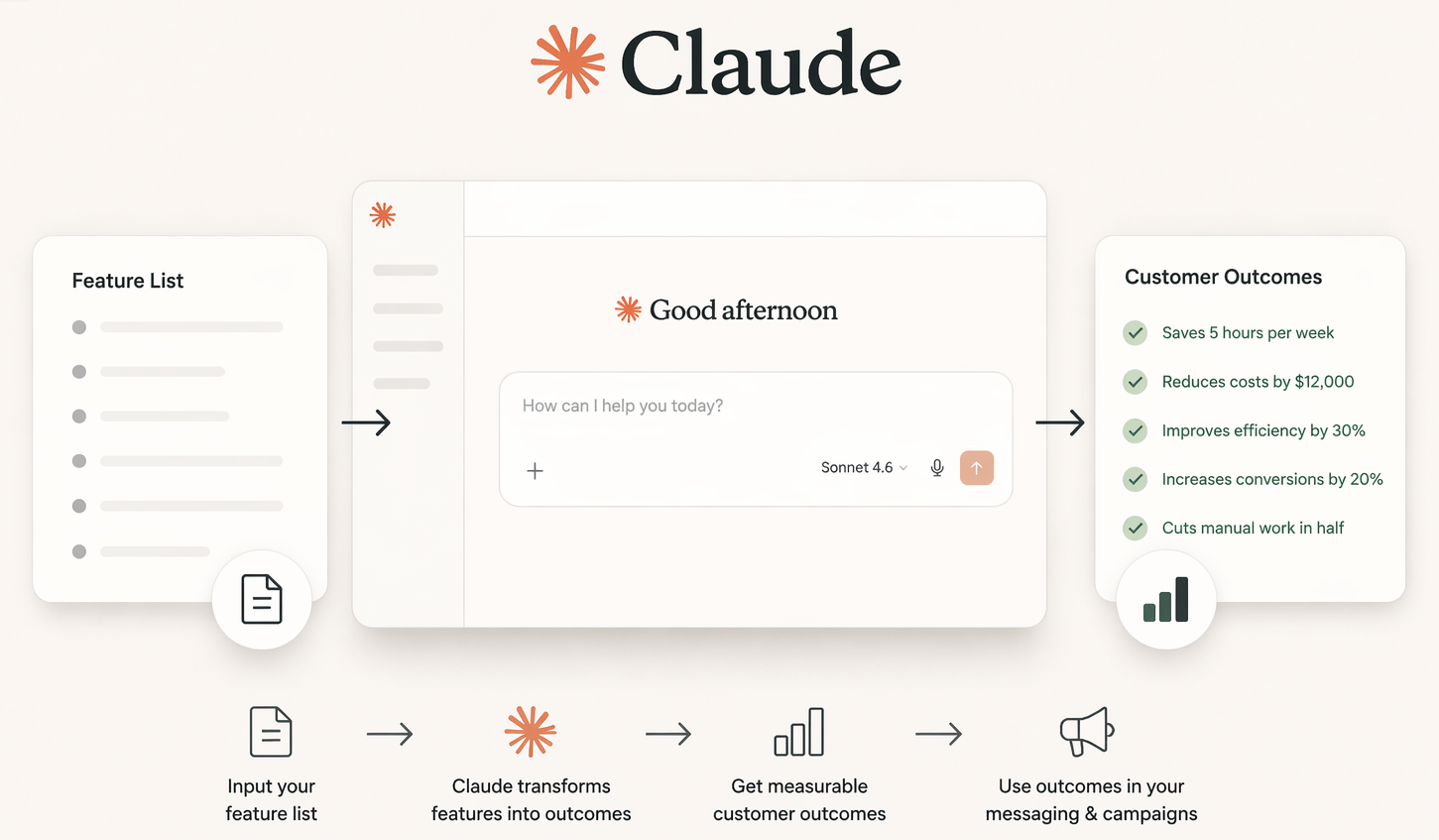
What it does: Takes your feature list and turns every feature into a measurable customer outcome. Instead of "our platform has automated reporting," you get "your team saves 5 hours per week on manual reports, worth roughly $12,000 per year per rep."
Use it for: A free 10-minute messaging overhaul. Paste your existing feature list into Claude, ask it to convert each feature into a quantified outcome, and you walk away with a set of selling points that actually close deals.
Quick play:
- Open Claude. Create a Project and upload your product brief, homepage copy, and any sales collateral you have.
- Paste in your complete feature list. Then use this prompt: "Here is our product feature list. For each feature, write one sentence that describes the measurable outcome a customer gets. Quantify it in dollars, hours saved, or percentage improvement. Do not mention the feature. Only mention what changes for the customer after they use it."
- Review the output. Claude will give you 10 to 20 outcome-based selling points. Pick the 5 that feel strongest.
- Turn those 5 outcomes into ad copy, landing page headlines, or cold email subject lines. Now you have messaging ready to test through your performance marketing channels.
- Run them through paid channels (LinkedIn Ads, Meta, Google) to see which outcome resonates most with your audience. Scale the winner.
That's your outcome messaging engine. Feature list in, customer outcomes out, tested with real traffic.
Growth Play of the Week
The Play: Testing outcome-based selling points with performance marketing
Problem: Your business leads with features. "AI-powered automation." "Enterprise-grade security." "50+ integrations." Your prospects hear these same claims from every competitor. Nothing stands out. Nothing converts.
Stack:
- Claude (to convert features into quantified outcomes)
- A paid ad platform you already use (LinkedIn Ads, Meta, Google)
- A simple A/B testing system (even a spreadsheet tracking CTR and conversion per variant works)
- A CRM to track which messaging leads to actual closed deals
Workflow:
- Run the Claude feature-to-outcome exercise. From the Tool of the Week. Turn your entire feature list into quantified outcomes. Choose your top 5.
- Build 5 messaging variants. Each variant leads with a different outcome. Not 5 different taglines. 5 different core promises. "Cut reporting time by 80 percent." "Close deals 29 percent faster." "Save $12,000 per rep per year." One outcome per variant.
- Launch them as ads. Put a small, controlled budget behind each variant. LinkedIn Ads for B2B. Meta for B2C. Google for intent-based. Keep audiences identical across variants. The only thing that changes is the outcome you lead with.
- Measure which outcome gets the most clicks and conversions. After 7 to 14 days, one or two outcomes will clearly outperform the rest. That is your market telling you what it actually cares about. Feature-based messaging never gives you this signal.
- Take the winning outcome and scale it. Put more budget behind it. Use it on your homepage. Put it in your cold outreach. Use it on your sales decks. You now have a data-backed answer to "what makes our product different."
- Repeat every quarter. Markets shift. Competitors copy. The outcome that works today may not work in six months. Make this a recurring process, not a one-off project.
Outcome:
→ A messaging strategy backed by actual conversion data, not internal opinions
→ Higher CTR and lower CPA because your ads speak to what buyers actually want
→ A systematic way to stay ahead of competitors who are still guessing
Case Study
Microsoft Teams vs. Slack
The most instructive example of distribution beating product is one most people have lived through without noticing it.
Slack launched in 2013 and quickly became one of the most beloved workplace products ever built. The user experience was thoughtful. The onboarding was delightful. The brand was sharp. For years it was held up as the gold standard of product‑led growth.
Then Microsoft launched Teams. Microsoft integrated Teams directly into Microsoft 365, which already held roughly 58 percent of the enterprise productivity suite market. Companies already paying for Office got Teams automatically. The product was, by most accounts, inferior. Users complained about the interface, the notifications, the overall experience.
It didn't matter.
Microsoft Teams grew from 2 million daily active users in 2017 to 320 million in 2023, according to Statista. Slack, the product people genuinely preferred, reached 32.3 million daily active users. That is a nearly 10‑to‑1 ratio in favour of the worse product with the better distribution.
The lesson isn't that product quality doesn't matter. It is that distribution determines whether anyone ever sees your product quality in the first place. Slack was earlier to market with a better product, and it still lost. Because Microsoft already owned the channel, and owning the channel meant owning the customer.
For businesses operating in 2026, this lesson is more urgent than ever. The cost to build a good product has collapsed to near zero. The cost to build a proprietary distribution channel has only gone up. The businesses that invest in distribution now are the ones that will still have customers when the market gets more crowded, because the market always gets more crowded.
Trend to Watch
Three things are converging right now that make outcome-based selling, combined with performance marketing, the only sustainable growth strategy.
First: AI has made building so cheap that anyone can ship. When everyone can build, building stops being an advantage. What's left is the ability to reach people and convince them your product will change something measurable in their business.
Second: Feature-based selling is dying. Gartner found that 87 percent of B2B deals stall because sellers talk about features instead of outcomes. In a market where every competitor has AI-powered everything, features are noise. Outcomes are signal. And the only way to know which outcome actually makes someone buy is to test it with real traffic.
Third: Performance marketing gives you that testing speed. Organic channels take months to generate enough data for a statistically meaningful comparison. Paid channels give you answers in days. The businesses that win over the next two years will not just own distribution channels. They will own the feedback loop between messaging and market response, powered by performance marketing budgets they control.
The window to build this system is open now. It won't be open forever.
Prompt of the Week
Ask yourself and your team these five questions:
1. Take your current homepage or ad copy. Does it lead with a feature ("AI-powered platform") or an outcome ("Your team ships 40 percent faster")? If it leads with a feature, you are competing on price, not value.
2. When was the last time you tested two different outcome-based messages against each other with real ad spend? If the answer is "never," you are guessing what your market cares about.
3. What percentage of your new customers come from channels where you can control the traffic volume (paid) versus channels where you wait for algorithms to send people your way (organic)? If you rely entirely on organic, you cannot test at speed.
4. If you had to write 10 quantified customer outcomes for your product right now, without looking at your website, could you do it? If not, your messaging is still feature-based.
5. Is your performance marketing budget being used to test new messaging angles every quarter, or is it just maintaining existing campaigns? If the latter, your competitors who are testing will outlearn you.
The answers to these questions tell you whether your growth engine is built for the 2026 market or the 2016 one. Most leadership teams never ask them.
Distribution is the moat. But the moat means nothing if your message is all features and no outcomes. The businesses that win combine three things: a distribution channel they control, outcome‑based selling points that actually convert, and performance marketing to test and scale the winners fast.
If you want help building that system inside your business, we should talk.
→ Reply "AI" and my team will help you figure out where to start, or