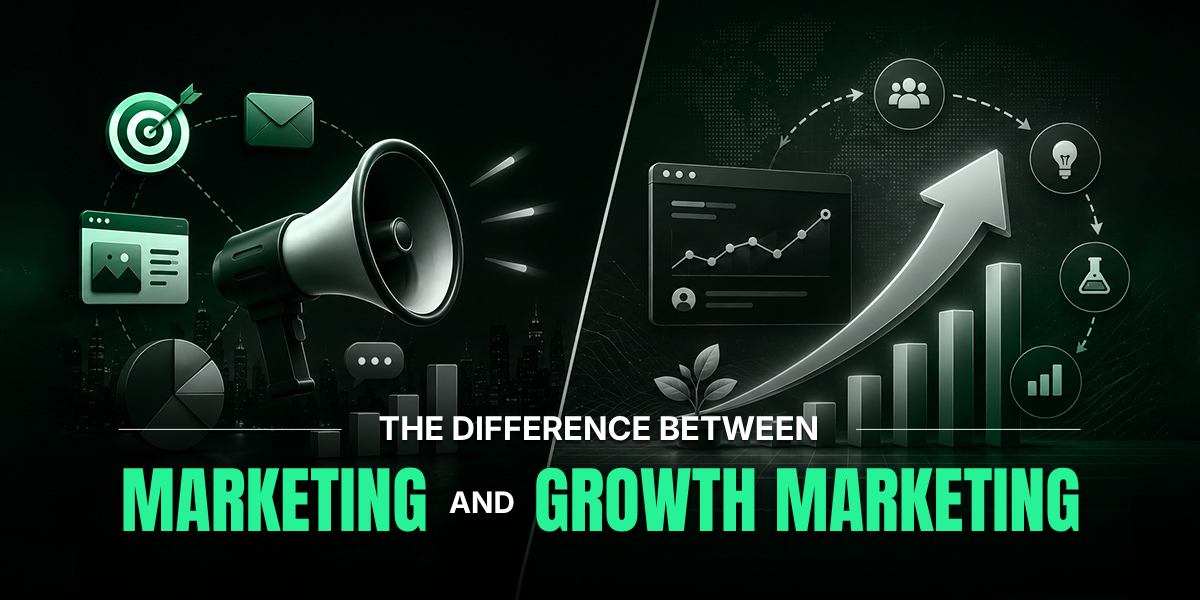
Today I want to talk about something that comes up all the time. People ask me, "Jake, what's the difference between growth marketing and just... marketing?"
The short answer is this. It is not about the channels. It is about the mindset.
Most businesses treat marketing like a switch. You turn it on. You run some ads. You send some emails. You get some customers. Then you turn it off and move to the next thing.
That's not growth marketing. That's just marketing. And there is a big difference.
The Real Difference
Marketing is campaign oriented. You launch a product. You promote it. You measure clicks and impressions. You celebrate the sale. Then you move on to the next campaign.
The goal is awareness. The goal is a transaction.
Growth marketing looks at the whole picture. A growth marketer doesn't stop at the sale. They ask what happens next. How do we keep this customer? How do we make them more valuable? How do we turn them into someone who brings us more customers?
Traditional marketing often stops at the sale. Growth marketing starts there.
Let Me Give You An Example
A marketer runs a campaign. They acquire a customer for $500. They hit their number. They celebrate. Job done.
A growth marketer looks at that same $500 acquisition and asks a different set of questions.
- What happens next?
- How do we keep this customer?
- How do we get them to buy again?
- How do we turn them into a referral?
One is transactional. The other is relational.
Four Big Differences
Let me break this down simply.
1. Time Horizon
Marketing chases quick wins. Flash sales. Limited time offers. New product launches. The goal is short term revenue.
Growth marketing plays the long game. It's about building relationships that grow over time. You're not just thinking about this month. You're thinking about lifetime value. You're thinking about retention. You're thinking about how each customer becomes more valuable the longer they stay.
2. Where You Focus
Marketing is obsessed with the top of the funnel. Awareness. Acquisition. Getting new people in the door. That's all they care about.
Growth marketing cares about the whole funnel. Acquisition matters. But so does activation. So does retention. So does referral.
Here's the reality. Acquiring a new customer can cost five times more than keeping one you already have. And loyal customers tend to spend more over time.
If you are only focused on getting new customers, you are leaving money on the table.
3. How You Make Decisions
Marketing is often opinion based. A senior leader has a hunch. You run with it. You evaluate the campaign at the end of the quarter. Maybe it worked. Maybe it did not. Hard to know.
Growth marketing is data driven. You test. You measure. You learn. You run experiments constantly to see what actually moves the needle. You don't guess. You know.
4. What You Measure
Marketing measures reach. Impressions. Brand awareness. Things that feel good but don't always pay the bills.
Growth marketing measures what actually matters for the business. Conversion rates. Churn. Retention. Customer lifetime value. LTV to CAC ratio.
Impressions don't pay the bills. Revenue does.
What Growth Marketing Really Is
Now let me be clear about something.
Growth marketing is not a secret hack. It's not some magical formula that only a few people know. It's the product of doing many related things exceptionally well. It's about walking the line between data and creativity. It's about getting things done. It's about doing the fundamental things right, over and over again, at an extremely high level.
That is what I have always believed. And that is what the Full Stack Growth System is built on.
The One Thing I Want You To Remember
If you are running a business and you only think about marketing as "how do we get more customers?" you are doing it wrong.
That's marketing thinking.
Growth marketing asks a better question.
How do we get more customers, keep them longer, make them more valuable, and turn them into advocates who bring us even more customers?
That is the system. Acquisition feeds into retention. Retention feeds into referral. Referral feeds back into acquisition. It is a machine that compounds over time.
That is how you build a business that scales.
Final Thought
The next time someone asks you about your marketing strategy, don't just tell them about your ad spend.
- Tell them about your full customer journey.
- Tell them about your LTV.
- Tell them about your retention.
- Tell them about your referrals.
Because that's the difference between marketing and growth marketing.
And that difference is the difference between a business that survives and a business that scales.
P.S. If you are still thinking about marketing as just getting customers, go back and read my newsletter on LTV to CAC. Until you understand that the real money is made after the first sale, you are never going to build a business that truly scales.
And if you want to go deeper on this, I just launched a WhatsApp community where we continue these conversations every day. We talk about real systems, real breakdowns, and what is actually working right now. If that sounds like your kind of space, come join us. Click the button below.