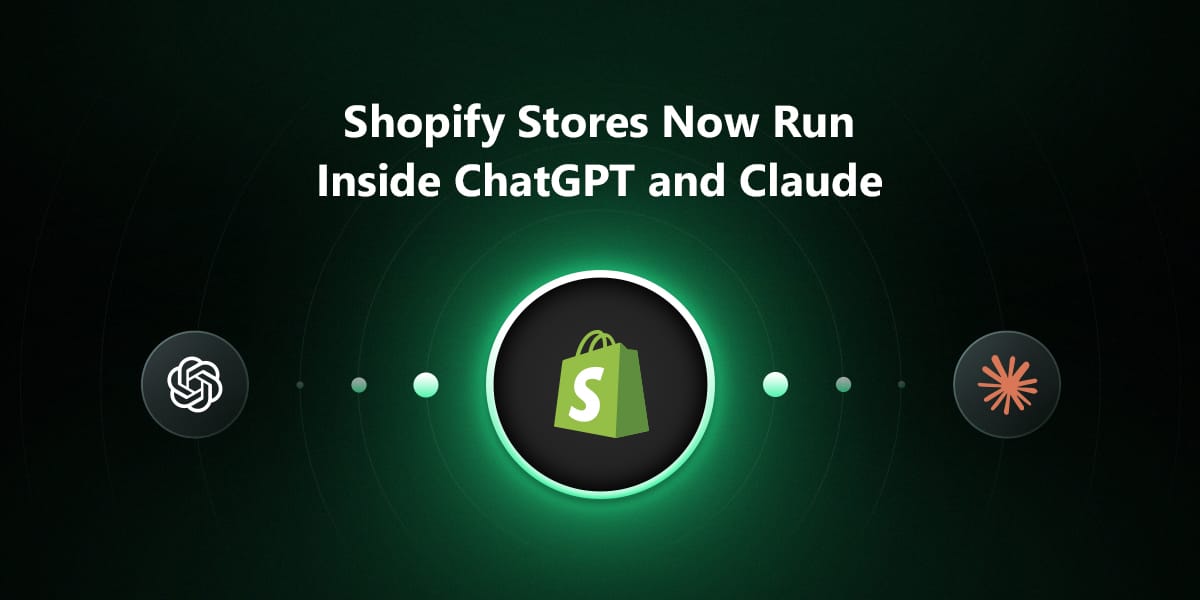
On May 2026, Shopify announced merchants can now connect their store to ChatGPT or Claude and manage it from inside the chat.
Ask how sales went yesterday. Add a new product. Check an order. All by just typing a message. Just type, that's it.
Most merchants will treat this as a productivity hack. The smart ones will see it for what it is: the operating system of running an e-commerce business just changed.
What Matters This Week
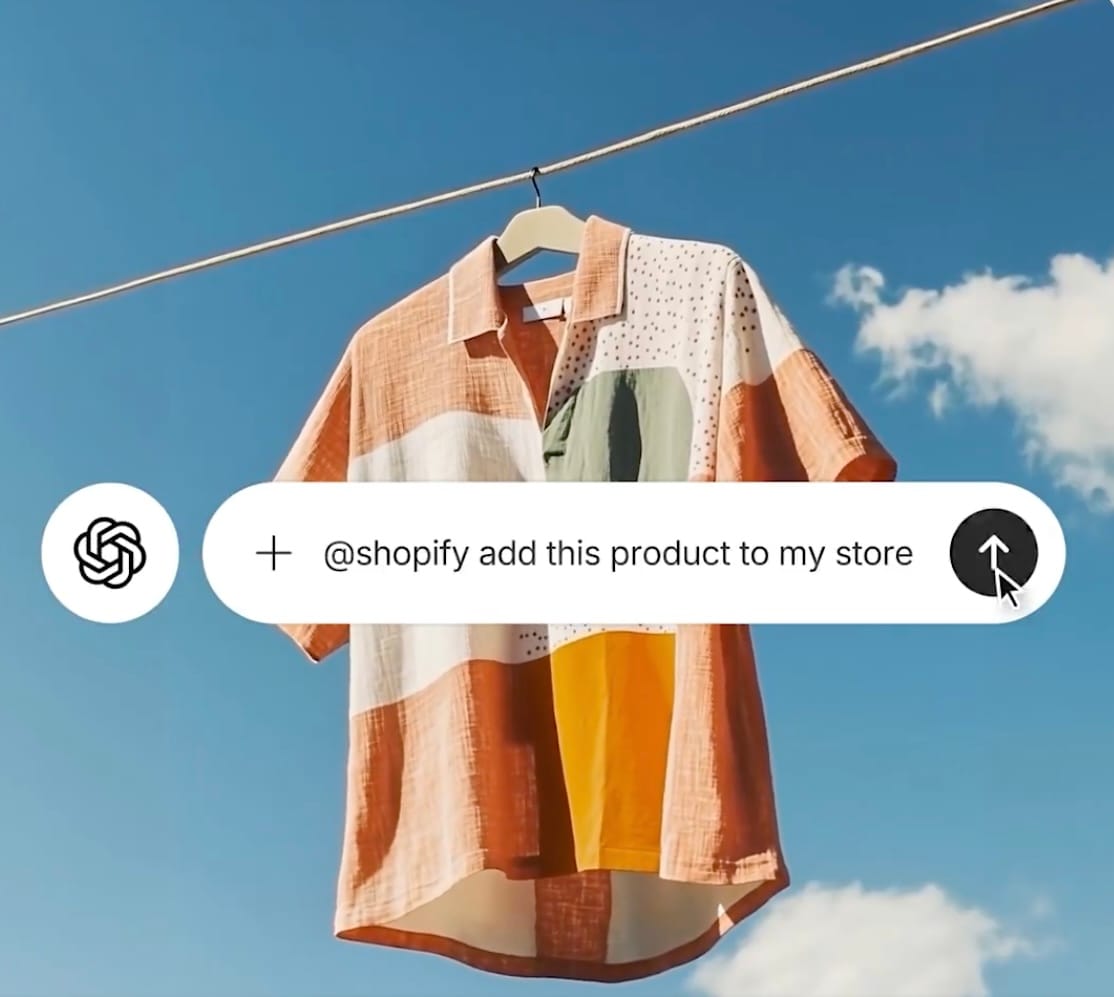
Shopify just put store management inside ChatGPT and Claude (May, 2026)
- What happened: Shopify announced merchants can now connect their store to third-party AI tools. Once connected, those tools can pull your store data and do stuff for you. Add products, update prices, look up orders.
- Why it matters: Running a store stops being something you click through. It becomes something you talk to. The merchants who learn how to ask the right questions will move faster than the ones still hunting through menus.
This is a separate release from Agentic Storefronts (March 24, 2026)
- What happened: Shopify made 5.6M stores discoverable to shoppers inside ChatGPT. This new May 4 release is about merchants managing their store from inside ChatGPT or Claude. Two different audiences. Same protocol underneath (MCP).
- Why it matters: Shopify is now the AI layer on both sides. Discovery for shoppers, operations for merchants.
AI-attributed orders up 15x in 2025
- What happened: According to Shopify's own data, AI-attributed orders grew 15x between January and November 2025. AI-referred traffic grew 7x in the same window.
- Why it matters: The shopper-side shift already happened. The merchant-side shift just started. Same playbook applies, early movers win.
Shopify's Sidekick is built on Claude
- What happened: Shopify's in-admin AI assistant runs on Claude Sonnet 4.5. The Director of Applied AI confirmed this is an architectural choice. Now the same model family is being opened up to merchants on the outside.
- Why it matters: Anthropic is becoming infrastructure for ecommerce ops. Worth watching if you're picking which AI tools to invest time in.
The unlock is for non-developers
- What happened: Earlier in April, Shopify shipped the AI Toolkit but that required Claude Code, terminal access, Node.js. This new release works with consumer ChatGPT and Claude apps. No code.
- Why it matters: This is the first release that hands AI store management to the people who actually run stores, not just developers.
Tool of the Week
Tool: Shopify's MCP Connector for ChatGPT and Claude
What it does: Connects your Shopify store directly to ChatGPT or Claude via the Model Context Protocol. Once linked, you manage your store through natural conversation. Authorized actions include adding products, looking up orders, pulling sales reports, updating pricing, tagging products, and adjusting inventory, all without leaving the chat.
Use it for: Replacing repetitive admin work. Instead of clicking through the Shopify dashboard, you type. Tag products, check order status, pull sales data, update prices, all without leaving your AI chat.
Quick play:
- Open Shopify admin and look for the AI tools / connectors setting (Shopify will surface a notification when it's available for your store).
- Connect ChatGPT or Claude. You authorize what data and actions the AI can access.
- Start with read-only queries. "How did sales go yesterday?" or "Which products are low in stock?" Let the AI prove itself before you give it write access.
Growth Play of the Week
The Play: Building an AI Operations Layer for Your Store
Problem: Most merchants spend 5–10 hours a week on repetitive admin work. Looking up orders, updating product copy, checking inventory, pulling reports. That time isn't growth work.
Stack:
- Shopify (with the new May 4 ChatGPT/Claude connection enabled)
- Claude or ChatGPT (Claude free works with 1 connector; ChatGPT needs Plus or higher)
- A simple prompt library you build over time
Workflow:
- Audit your week. List every repetitive Shopify task that takes more than 10 minutes. That's your automation list.
- Connect your AI tool of choice. Start with whichever you already pay for. Authorize read access first.
- Build a prompt library. Save the prompts that work. Examples: "Show me products with no sales in 30 days." "Which customers have spent over $500 lifetime?" "Pull yesterday's orders by region."
- Add write access carefully. Once you trust the AI on reads, give it limited write access and start with low-risk actions like tagging or description updates. Always review before bulk operations.
- Document what you save. Track hours saved per week. This is your ROI proof for scaling further.
Outcome: → 5–10 hours/week back on repetitive admin → Faster decision-making (no waiting for reports) → A repeatable system, not a one-off hack
This is the work agencies will charge $5K/mo to build for clients in 6 months. Build yours now.
Case Study
There isn't one yet and that's the point
The May 4 release is days old. No brand has published results from running their store through ChatGPT or Claude yet.
But here's what happened last time Shopify dropped something like this:
- Late 2025, ChatGPT shopping launched. Glossier, SKIMS, Spanx, Vuori jumped in early. Their product data was already clean. By the time Agentic Storefronts went live for everyone on March 24, those brands were already showing up in ChatGPT recommendations. By then, AI-attributed orders had already grown 11x, proving the early demand. Their competitors were still googling "what is Agentic Storefronts."
Same thing's gonna happen with this one.
- In three months, somebody's gonna write the case study. Some merchant who started this week, figured out how to run their whole store through Claude or ChatGPT, and now saves a stupid amount of time every week. They'll get featured everywhere.
The takeaway: That merchant could be you. But only if you start now. Before the case studies exist, before the proof is in, while everyone else is still asking if it's even worth trying.
That's how it always works with new tools. The people who win don't wait for proof. They become the proof.
Trend to Watch
McKinsey: $3–5 trillion in agentic commerce by 2030.
McKinsey's October 2025 research projects agentic commerce could orchestrate $3T to $5T globally by 2030, with up to $1T in US B2C alone. They compare the impact to the web and mobile revolutions but predict it'll happen faster, since agents ride the same digital rails humans already use.
The pattern to watch: AI is becoming the way people interact with commerce, on both sides. Shoppers ask AI what to buy. Merchants ask AI how their store is doing. The dashboard era isn't ending but it's becoming the backup, not the main way.
If your team isn't building AI workflows now, your competitors will be running their stores faster than you can. That gap gets harder to close every month.
Hot Take
In 24 months, asking "do you use AI to run your store?" will sound like asking "do you use email?" today.
Most merchants will spend that time arguing about whether it's worth learning. A smaller group will spend it building workflows that turn 10 hours of admin into 1.
The gap between those two groups will be the biggest growth story of 2026.
Prompt of the Week
Once you connect Shopify to ChatGPT or Claude, paste this in to start your AI ops workflow:
"Connect to my Shopify store. Show me: (1) yesterday's total revenue and order count, (2) my top 5 products by units sold last 7 days, (3) any products with inventory below 10 units. Format as a clean summary I can read in 30 seconds."
Run this every morning. It replaces 3 separate admin reports with one prompt. Customize the metrics for your business.
If you want help building AI-powered growth systems inside your business:
→ Reply “AI” and I’ll point you in the right direction, or