OpenAI released GPT-5.5 last week, and if you're trying to grow a business right now, this changes how fast you can actually move.
GPT-5.5 is the model OpenAI is calling "a new class of intelligence for real work." It's the most agentic model OpenAI has shipped to date. Four things actually changed, and every one of them affects how you grow.
What Matters This Week
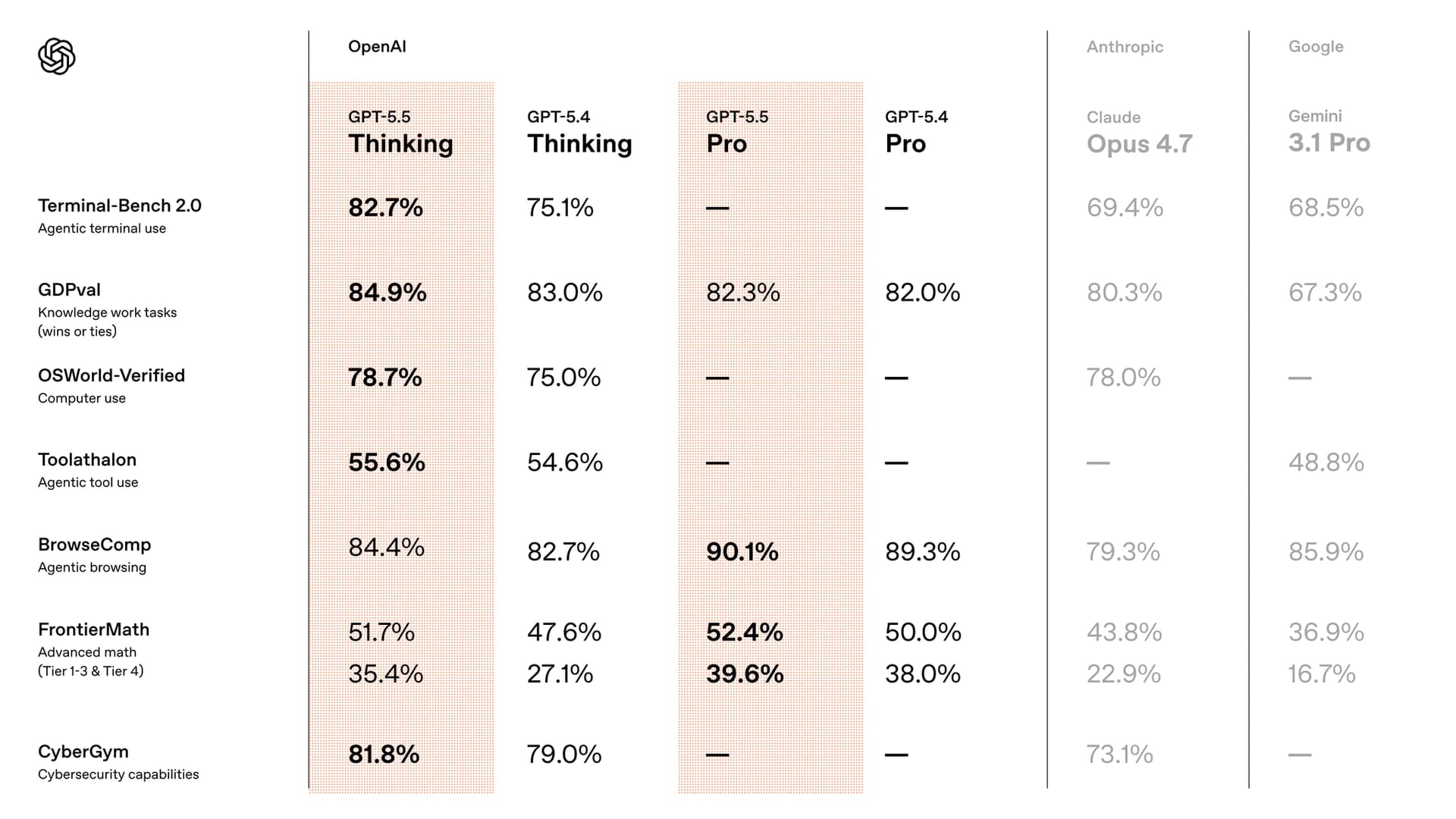
GPT-5.5 is live and it's built differently
- What happened: OpenAI released GPT-5.5 on April 23rd, just six weeks after GPT-5.4 dropped. It's available now for Plus, Pro, Business, and Enterprise users on ChatGPT and Codex.
- Why it matters: The speed of releases alone tells you something. OpenAI isn't iterating slowly. They're shipping almost on a monthly cadence and every release is closing the gap between "AI tool" and "AI worker."
This is OpenAI's first real agent play
- What happened: GPT-5.5 is built to handle messy, multi-part tasks like planning, using tools, checking its own work, navigating ambiguity, and finishing the job without you managing every step.
- Why it matters: Previous models were great at answering questions. GPT-5.5 is built to complete work. That's a different product category entirely. The implication for your team: fewer people doing repetitive multi-step tasks, more people doing the thinking that AI still can't.
OpenAI's own teams are already using it internally
- What happened: Inside OpenAI, one Go-to-Market employee automated their entire weekly reporting process using GPT-5.5 in Codex, in result saving 5 to 10 hours every week. Their Finance team used it to review over 24,000 tax forms. Their Comms team built a Slack agent to auto-handle low-risk requests.
- Why it matters: This isn't theoretical anymore. These are real workflows, real time savings, inside a real company. If OpenAI is running their own operations this way, you should be taking notes.
The "super app" vision is getting real
- What happened: OpenAI president Greg Brockman said GPT-5.5 brings the company closer to building a "super app". One that combines ChatGPT, Codex, and AI browsing into a single product for enterprise customers.
- Why it matters: The platform wars are coming. Whoever builds the go-to "all-in-one AI operating system" for business wins a generation of users. This is OpenAI's clearest signal yet that that's where they're headed.
Tool of the Week
Tool: ChatGPT + Codex (GPT-5.5)
What it does: Handles complex, multi-step work like coding, research, data analysis, document creation across tools, with minimal back and forth.
Use it for: Building internal automation workflows without needing a developer.
Quick play:
- Open Codex (available on Plus and above)
- Give it a messy, multi-step task like "Review last month's sales data, flag anything unusual, and write a summary I can share with my team"
- Let it run. Review the output. Tweak once or twice.
The key shift: stop treating it like a search engine. Give it an actual job to do.
Less time on internal updates. More time selling, building, and closing.
Growth Play of the Week
The Play: AI-Powered Weekly Reporting System
Problem: Founders and marketers spend hours every week pulling together updates, reports, and status docs. It's low-value but high-effort work.
Stack:
- GPT-5.5 in Codex
- Your existing data sources (CRM, spreadsheets, analytics dashboards)
- Notion or Google Docs for output
Workflow:
- Export your weekly data (leads, revenue, traffic, whatever you track) into a single doc or spreadsheet
- Feed it to GPT-5.5 with a prompt like: "Summarize performance this week, flag any outliers, and write a 1-page update for a business owner"
- Review the draft, add your own context, and send
Outcome:
→ What used to take 3–4 hours takes under 30 minutes
→ You get a consistent, clean format every week
→ You free up brain space for actual decisions
This is exactly what OpenAI's own Go-to-Market team is doing. Cutting 5 to 10 hours of weekly reporting work using this exact setup.
Case Study
→ How a Math Professor Built an App in 11 Minutes
What happened: During OpenAI's press briefing, Greg Brockman pointed to an example of a math professor who used GPT-5.5 and Codex to build a working algebraic geometry app from a single prompt in 11 minutes.
Why it worked:
- He didn't write code. He described a problem.
- GPT-5.5 handled the planning, building, and verification.
- The whole process required almost no technical hand-holding.
Takeaway: The gap between "having an idea" and "having a working thing" is basically nothing now. If a math professor can ship a working app in 11 minutes, think about what you could build, test, or automate in your business this week. So if you're a non-technical founder or operator, this one's for you.
Hot Take
Everyone's asking if GPT-5.5 changes everything. Wrong question
Model releases used to feel like big events. Now they feel like software updates.
GPT-5.5 dropped just six weeks after GPT-5.4. Before that, GPT-5.3. Before that, GPT-5.2.
We are now in a world where the AI you're using today will be outdated in a month.
And honestly? That's good news. Because it means the competitive edge is no longer "which model do you use." It's whether you've built the habit of using these tools at all. Most people haven't. They're still sleeping on it. You don't have to be.
If you need help building this inside your business, you can either:
→ Reply “AI” and I’ll point you in the right direction, or