If every revenue problem makes you go looking for more customers, you’re leaving money on the table.
Most businesses obsess over getting customers cheaper. But the bigger opportunity is often sitting right in front of them: making each customer worth more.
Your first sale is only the beginning.
If you spend $500 to acquire a customer and they buy a $500 product, you’ve recovered the revenue from that first sale, but there isn’t much room left for profit or growth.
Now imagine that customer gets a great result, trusts you, and later buys another $1,000 product. That customer has now generated $1,500 in revenue from a $500 acquisition cost.
You didn’t make the customer cheaper to acquire. You made the customer more valuable.
That’s why CAC and LTV need to be looked at together. A business that can increase LTV has more room to invest in acquisition. And that can make a huge difference when you’re trying to scale.
Here Are Five Ways To Create More Revenue From The Customers You Already Have
1. Find the customers most likely to return
Not every customer has the same future value. Some people buy once and disappear. Others purchase repeatedly, spend more, or eventually become loyal advocates.
Start by comparing your repeat customers with your one-time customers.
Look at:
- Where did they come from?
- What did they buy first?
- How much did they spend?
- How long did it take them to buy again?
- What did they buy next?
You’re looking for patterns. You might discover that customers from one channel are far more likely to buy again than customers from another.
That tells you something important about the quality of the customers you’re acquiring, not just the cost of acquiring them.
2. Understand what makes people buy again
The second purchase usually happens for a reason, often tied to a specific moment, need, or trigger.
Maybe the customer has finished the product. Maybe they got their first result and are ready for the next step. Maybe they have another problem that your business can solve.
Look at the customers who came back and work backwards.
- What happened before they purchased again?
- How long did they wait?
- What did they buy next?
- Had they completed onboarding?
- Had they already experienced a good result?
Once you understand what triggers the second purchase, you can build more of that into the customer experience.
3. Give customers a useful reason to return
Don't wait for customers to remember your business when they need you again. Help them understand what they may need next.
That could be:
- A refill.
- A complementary product.
- A bundle.
- A higher-tier package.
- A maintenance service.
- A subscription.
- A product that solves the next problem in their journey.
Imagine a customer buys a £100 skincare product that usually lasts three months. Instead of sending random promotions, you could:
- Help them get the best result from the product.
- Remind them when they may be ready to reorder.
- Recommend a relevant complementary product.
- Make the next purchase easy.
This is more effective than simply saying, “Come back and buy something.”
The goal isn't to push another sale. The goal is to make the next purchase feel timely, relevant, and useful. If you solve the next problem at the right time, the customer has a reason to keep buying from you.
4. Find out why customers don't return
This is where many businesses look in the wrong place.
A customer buys once and disappears, so the business starts looking for more traffic. But what if the problem is what happened after the sale?
Maybe the customer didn’t get the result they expected. Maybe the product was difficult to use. Maybe onboarding was poor. Maybe they didn’t know what to do next. Maybe buying again was harder than it needed to be.
Look at the customers who didn’t return and find where their journey broke. Fixing that problem could be more valuable than spending another $10,000 trying to acquire more customers.
5. Turn loyal customers into a growth channel
Your best customers can create value beyond their own purchases.
They can help you acquire new customers by:
- Referrals.
- Reviews.
- Testimonials.
- Case studies.
- User-generated content.
- Word-of-mouth recommendations.
- Social sharing.
Start by identifying customers who:
- Have achieved a strong result.
- Buy regularly.
- Spend more than average.
- Leave positive feedback.
- Engage with your brand.
- Recommend you to other people.
Then make it easy for them to share their experience.
Ask for a review after a successful outcome, not immediately after the transaction. Invite strong customers to participate in a case study. Create a referral offer that rewards both the existing customer and the new customer.
The principle is simple: A great customer experience can generate both retention and acquisition.
The Bigger Picture
Getting the first sale is only one part of the customer journey. The real opportunity is what happens afterwards.
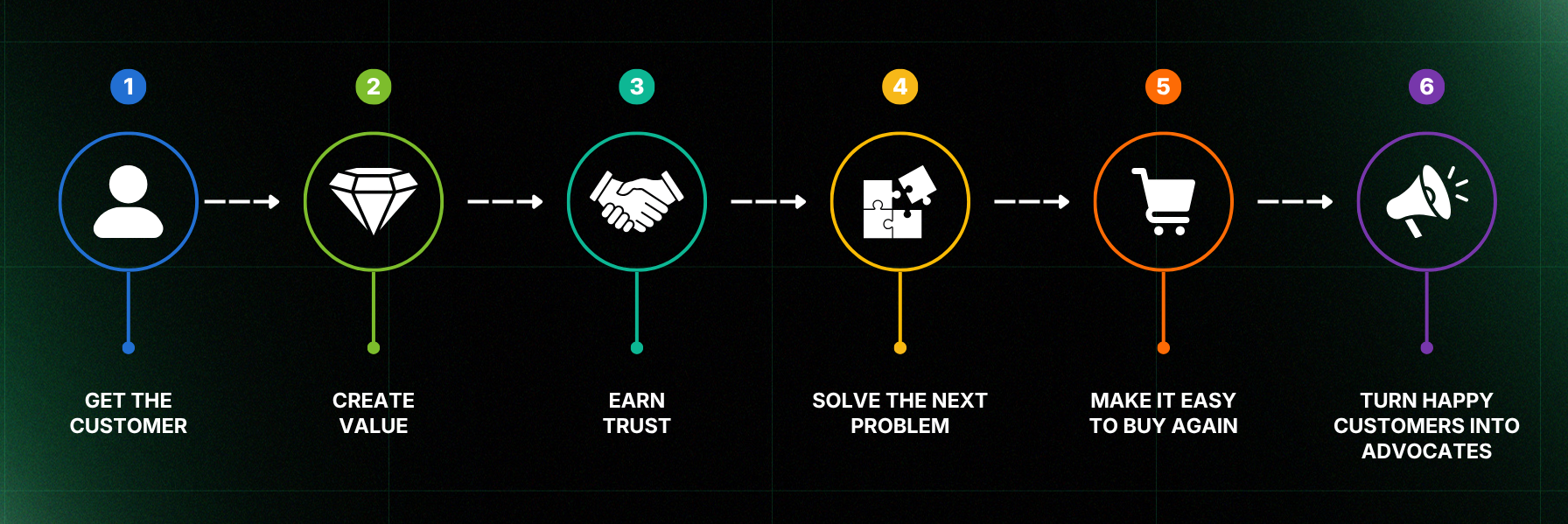
That’s the thinking behind the Full Stack Growth System.
You can keep trying to reduce CAC, but there’s a limit to how cheap you can acquire a good customer.
There’s much more room to build a business where each customer becomes more valuable over time. So the next time sales slow down, don’t automatically ask: “How do we get more customers?”, but ask: “How much more value can we create for the customers we already have?”
Because sometimes the next stage of growth isn’t outside your business. It’s already sitting inside your customer base.
Want to find the growth opportunities in your customer journey?
If you want to see how the Full Stack Growth System can help you find more opportunities to increase customer value, I put together a free PDF that walks through all six stages of the system.
→ Reply “SYSTEM” and I’ll send it straight to your inbox.
Or, if you want us to look at your business specifically, book a free Growth Audit.