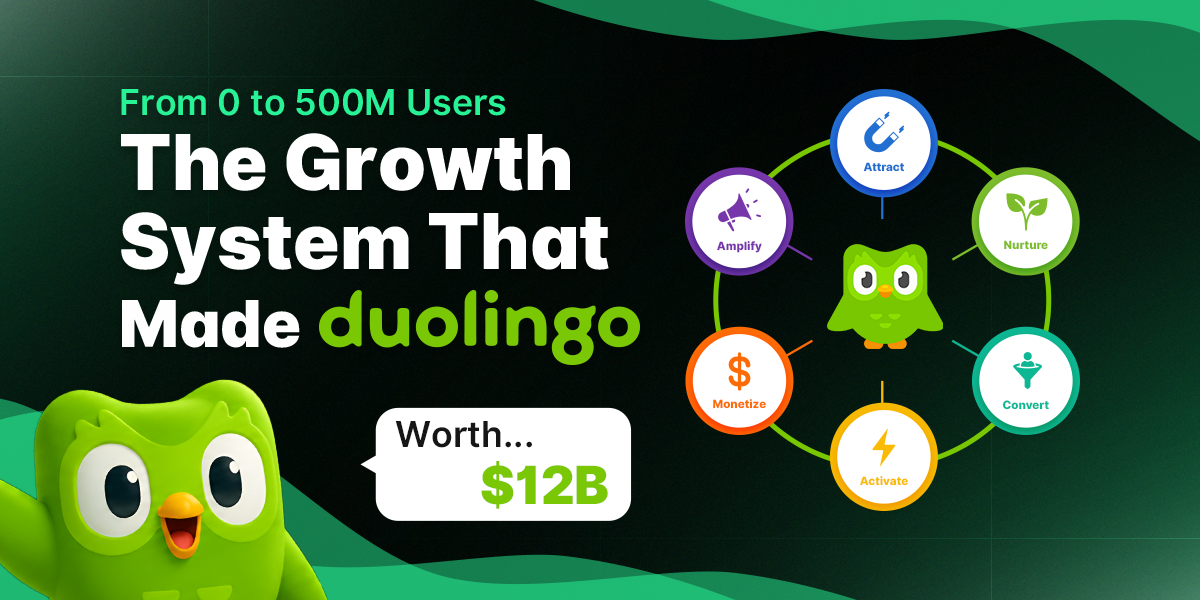
Most language apps spend millions on advertising to acquire users. Duolingo took a different path. They built an AI system called Birdbrain that distributes lessons like a private tutor. Personalised, perfectly timed, and just hard enough to keep you coming back.
That system now drives over 500 million downloads and a market cap well above $12 billion. The marketing budget is tiny compared to competitors. The engine does the work.
Here is exactly how Birdbrain works, and how Duolingo wired it into a full growth system that any business can learn from.
Case Study
Duolingo — How an AI Distribution Engine Built a $12 Billion Learning Habit
Duolingo started in 2011 as a free language app. By the end of 2025, it had surpassed 500 million total downloads, nearly 110 million monthly active users, and a market capitalisation above $12 billion. The surprising part isn't the scale. It's how little they spend to get and keep users compared to other consumer apps.
The secret is an AI system called Birdbrain. It was built to do one thing really well: get the right lesson to the right person at the right time. Birdbrain doesn't just ask "what should this user learn next?" It asks "what lesson is this user most likely to complete without quitting?"
Behind the scenes, it analyses each learner's past mistakes, the time of day they study, and the difficulty level that keeps them challenged but not frustrated. It then delivers exactly that lesson. This is pure content distribution, personalised down to the individual.
The same logic powers Duolingo's famously effective notifications. Birdbrain learns what time you're most likely to open the app and what kind of message you respond to. For some, it's a cheerful nudge. For others, it's the passive‑aggressive owl threatening your streak. Both are AI‑selected, not manually written for mass blast.
The financial results speak for themselves. Paid subscribers have grown to over 8 million, up from roughly 2 million in 2021. Daily active users continue to climb, and marketing spend remains low because the product itself brings users back. The company turned a net loss into consistent profitability while keeping engagement metrics at industry‑leading levels.
But the real lesson isn't Birdbrain alone. It's the way all these pieces connect. And when you step back and analyse their success through the lens of the Full Stack Growth System, a clear pattern emerges. Here's how I'd map what they built onto the six stages.
Sources: Duolingo 2024 Annual Report; Duolingo Q3 2025 Shareholder Letter; public statements by CEO Luis von Ahn on Birdbrain; company blog posts on AI and personalisation; Crunchbase for valuation and funding data.
The Full Stack Growth System Breakdown
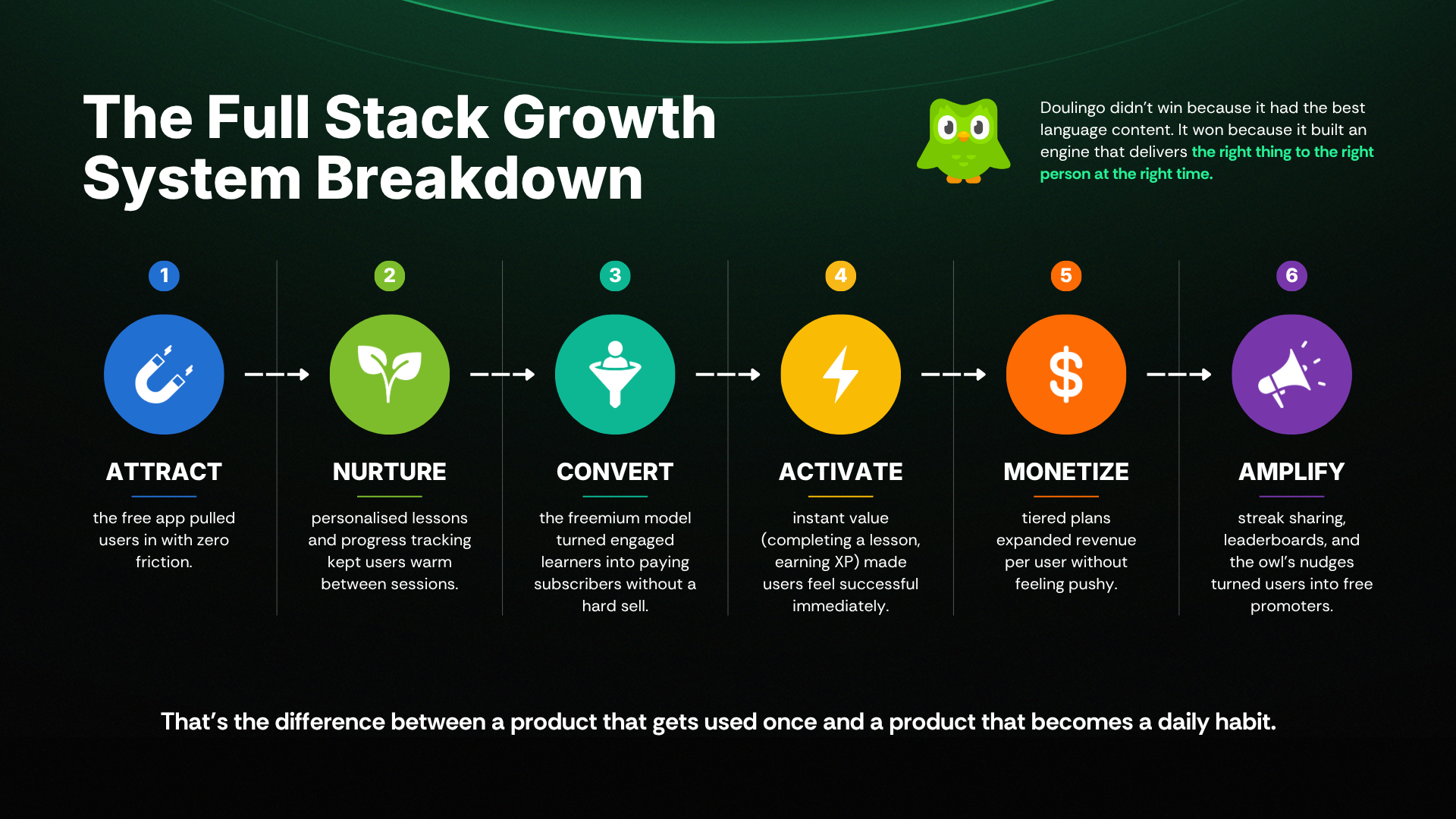
- Attract → the free app pulled users in with zero friction.
- Nurture → personalised lessons and progress tracking kept users warm between sessions.
- Convert → the freemium model turned engaged learners into paying subscribers without a hard sell.
- Activate → instant value (completing a lesson, earning XP) made users feel successful immediately.
- Monetize → tiered plans expanded revenue per user without feeling pushy.
- Amplify → streak sharing, leaderboards, and the owl's nudges turned users into free promoters.
Duolingo didn't win because it had the best language content. It won because it built an engine that delivers the right thing to the right person at the right time. That's the difference between a product that gets used once and a product that becomes a daily habit.
This is the Full Stack Growth System in action. Not a theory. Duolingo is just one example. Behind a lot of the big companies you know, the same six stages are quietly running the engine. Once you notice them, you'll see them everywhere.
Growth Play of the Week
The Play: Build a habit loop that reaches customers at the right time.
Problem: You send the same email or push notification to everyone at the same time. Response rates are falling and you can't figure out why.
Stack:
- An AI‑powered send‑time optimisation tool (Seventh Sense, Brevo, Klaviyo, or OneSignal)
- Your existing email or push platform
- Three simple behavioural segments: new users who haven't purchased, one‑time buyers who didn't return, and active users who suddenly went silent
Workflow:
- Create your three segments. "Just signed up but didn't buy." "Purchased once and never came back." "Used to be active but went silent for two weeks." These are the exact moments Birdbrain watches for.
- Write one relevant message per segment. New sign‑ups get a "here's your first win" guide. One‑time buyers get a cross‑sell based on what they bought. Quiet users get a "we miss you" that references what they used to love.
- Turn on AI send‑time optimisation. Don't pick a send time yourself. Let the tool decide when each person inside a segment is most likely to open and respond.
- Add a follow‑up rule. If a quiet user doesn't come back within 48 hours, send a second nudge with a different tone. Switch from friendly to a little guilt‑inducing, just like the owl does.
- Measure behaviour change, not just opens. Track how many quiet users came back. Track how many one‑time buyers placed a second order. Opens are a side metric. The real win is the action.
Outcome:
→ More re‑engagement without sending more volume
→ Every message lands when the person is most likely to respond
→ A loop that gets sharper as it learns about your audience
Trend to Watch
The next wave of AI distribution won't require a team of data scientists. It will be built into the tools you already use. Email platforms will automatically personalise send times. Push notification services will learn the right tone and frequency for each user. Even small businesses will be able to distribute their content, offers, and products the way Duolingo distributes lessons today.
The businesses that start now, even with a simple spreadsheet and a few behavioural segments, will have a head start. The ones that wait will find themselves competing with AI systems that have already learned what their customers want.
If you want to see what a Full Stack Growth System looks like for your business, I put together a free PDF that walks through the six stages stage by stage
→ Reply "AI" and I'll send it straight to your inbox.
Or take the faster route: book a free Growth Audit and my team will look at your current customer journey and show you exactly where to build a habit loop that lifts your revenue.